domingo, 15 de abril de 2012

Our Favorite Sins by Todd Hunter

I've read a lot of books about temptation but Todd Hunter really gets to the point when take the reader into the heart of the matter and take away the 'mystery clothing'. I mean, temptation is some mysterious weapon in the hands of the enemies of Jesus' people, but if you see it for what it is, well, you can see that temptation is a pretty dull thing.
If I'd have to choose one phrase out of the whole book it would be this: 'I can be tempted only when a desire I already have within me matches something that comes to my attention.' James said it in his epistle and Hunter translated it for us in his book. That's the reason why some people are tempted with drugs, some with social internet and some with gambling, for example.
The book tries to make the reader to understand that Temptation is not that powerful and that, if wanted, desires can be reoriented, defeating temptation in the process.
The only thing that I felt really strange is the 'prayer reading' stuff, but I suppose that this is because I'm not from that kind of church background.
Do I recommend this book? Well, if you're fighting with temptation and really want to start winning the battle, I strongly recommend the book.

viernes, 30 de marzo de 2012

Has God Spoken? by Hank Hanegraaff

It's been a few years since I've read this type of book and, even I loved it, it has some parts that are just too much. I mean, the author became a little redundant sometimes explaining things that were already clearly explained.
The other thing that I didn't like was the 'personal' confrontation type of writing. Hanegraaff wasted a lot of pages trying to show the lies in some of the 'christianity detractors' and, although it is ok (and I love to witness a good theological and logical confrontation), it go and go and go and go for pages and it eventually became a boring thing.
Nevertheless, I recommend this book because it is pretty much actual in the 'prophecy fulfillment' department.

viernes, 23 de diciembre de 2011

El peligro de ser "hijos de luz"


¿Alguna vez, cuando leíste Efesios 5:1 te dieron ganas de brillar como un hijo de luz debería brillar?
Aquí te comparto un pensamiento que publicamos en el blog de la iglesia.
Podés leerlo aquí.
Un abrazo!!!!!!

martes, 13 de septiembre de 2011

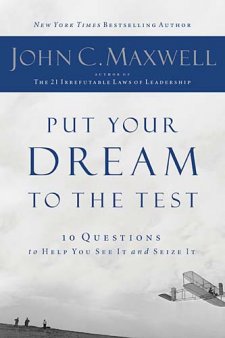
Put the test to the test

Put your dream to the test, by John C. Maxwell is a really useful book. In fact, it is so good that we made a whole Sermon Series at our church based in the book. Why? Because a dream "planted" from God into your heart is also a promise! Thus the importance of finding your dream, put it to the test and chase it.
This book came into my hands in a time of transition.
My wife and I have been half-time--planting-pastoring for 2 years a little church in Guatemala, Central America, and have beginning to dream about having more time for church. This book helped us to put a lot of dreams on the table and slowly but surely take a lot of those dreams out of the table, since they were pure fantasies and not dreams. There lies the power of these pages!
I mean, if you ask me to recommend you this book in one sentence, giving you just one reason to believe that this book has the potential to fire up you heart, it will be this: "Dreams are not enemies with reality! Fantasies are!"
That's huge!!!!!!!!!!!!!!!!!!!!!
Maxwell asks 10 questions and you're supposed to answer 'yes' to all of them. If your 10 answers are affirmative, then you may come to achieve your dream. If just one question is answered 'no', you have some homework to do in order to turn that 'no' into a 'yes'. Those 10 simple yeses are the difference between a dream and a fantasy.
Remember the 'dreams on the table' that I told you about? Well, the 'dreams' that had to be taken out weren't dreams but fantasies. 'Put your dream to the test' teaches you how to know the difference and challenges you to pursuit what your life has been promised by God in the form of a dream!
Read this book, discover your dream, put it to the test and conquer it!

martes, 2 de agosto de 2011

¿Candidato o plan de trabajo?

En estos tiempos de fascinación politiquera, muchos dicen que no tenés que votar por la "persona" que sale en la foto y que tampoco regalés tu voto en base a las promesas. Que, en cambio, tenés que informarte, tenés que conocer el plan de gobierno y las propuestas que cada candidato trae respecto a cada problema del país.

Sólo entonces es que ya podés votar por el plan de trabajo que tenga las mejores posibilidades de éxito o que vaya acorde a tu línea de pensamiento.
En resumen, dicen que no debo votar ni por la persona ni por las promesas, sino por el plan de trabajo.
Sin embargo, en mi cabecita hay una idea persistente: Un plan de trabajo de un candidato presidencial es una promesa ¿no? Es decir, técnicamente, un plan de trabajo no es más que un montón de promesas. ¿Por qué? Porque nada de eso se está haciendo, sino que se hará... digamos.

Así que, votar por el plan de trabajo es votar por un montón de promesas.

Ahora bien, cuando encontrás un "plan de trabajo" que parece que puede funcionar... tenés que confiar en que la o las personas detrás de dicho documento harán hasta lo imposible por convertir ese montón de teorías en un montón de prácticas exitosas. Y si necesitás confiar en que la persona "cumpla" su "plan de trabajo", entonces necesitás confiar en la persona, así que, al final, sí votás por la persona.

Ahora imagina que nuestro sistema de gobierno dejara a las "personas/candidatos" fuera de la ecuación de gobierno y sólo votáramos por "planes de trabajo" (es decir "promesas"). Aún así, tendría que haber una comisión o un comité o un ministerio o que trabajara por hacer que ese plan de trabajo llegue a convertirse en una realidad. De nuevo: Gente.

Y si a ese grupo le asignás un grupo de gente que lo audite, tenés que confiar en que los que cuidan a los que ejecutan, lo hagan honestamente. De nuevo: Gente.

Y si a este otro grupo les asignás más personas que los fiscalicen, la historia se repite. De nuevo: Gente.

Los planes de trabajo no se dejan corromper. Las personas sí. Y es por esto por lo que necesitamos gente en la que podamos confiar y no sólo planes de trabajo.
Sin menospreciar las promesas –o lo que es lo mismo, el plan de gobierno–, lo más importante es la persona ya que sin la persona, el plan no se puede ejecutar.

Así que, aunque mi forma de pensar puede ser un poco simplista (y no por eso deja de ser profunda) mi problema en estas elecciones presidenciales no nace de la falta de "planes de trabajo", ya que todos dicen más o menos lo mismo y todos funcionan igualmente bien (en teoría).

Mi problema nace de la ausencia de esa persona en la que puedo depositar mi confianza a través de una X en una papeleta.